
Why a literature review needs a map before an outline
Most people start a literature review by reading a paper and writing a page of notes on it. After thirty papers you have thirty pages, each one tidy and none of them connected. Then comes the hard part: the review you have to write is not a list of what each author did. It is an argument about what the field knows, where it disagrees, and what is still missing.
A mind map is a good tool for the step between reading and writing. It forces you to decide where each finding belongs, and it shows you the shape of the literature on one page. This guide explains how to build one, using the same structure as the literature review mind map template. You can follow it with pen and paper, a whiteboard or any mapping tool.
Why paper-by-paper notes make the review hard to write
Notes organised by paper answer the question "what did this author say?" A review has to answer a different one: "what do we know about this theme, and how sure are we?" When your notes are sorted by author, every paragraph of the review means searching through all of them for the three or four that touch the same point. You end up writing a chain of "Smith found… Jones found…" sentences because that is how the notes are arranged.
Organising by theme moves that work earlier. You do the grouping once, on the map, and the writing becomes a matter of walking through the branches.
The branches that work
Seven top-level branches cover most reviews. Rename them to fit your field, but keep the jobs they do.
- Research question: the question the review answers, and the scope you have set (period, population, kinds of study).
- Themes: the two to five groupings that your sources fall into. This is the branch that becomes the body of the review.
- Methods used: the designs, data and techniques the papers rely on, so you can see what kind of evidence sits behind each theme.
- Key findings: the results that matter for your question, placed under the theme they belong to.
- Gaps and disagreements: where papers contradict each other, and what nobody has studied yet.
- Sources to chase: papers that are cited a lot but that you have not read, and leads from reference lists.
- My position: what you think the evidence supports, and where your own work fits.
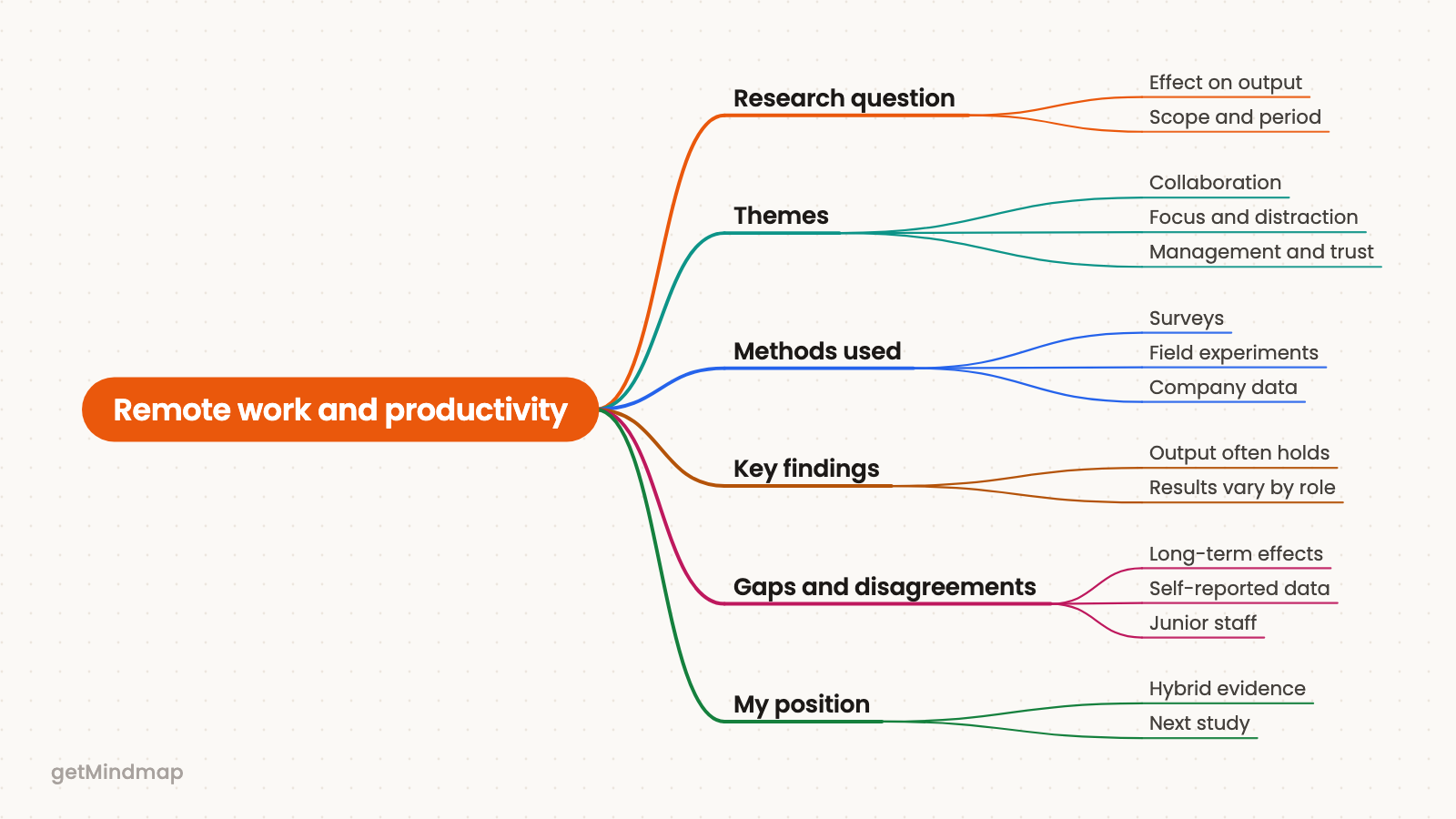
A step-by-step method
1. Collect abstracts and notes
Gather what you already have: abstracts, a few lines of notes per paper, the research question you started with. Do not start from full texts. The aim at this stage is a first pass over the whole field, not a deep read of each paper.
2. Draw a first map
Put the research question in the centre and add the seven branches. Drop each paper under whichever branch it seems to fit. This first version will be messy, and that is fine. If you would rather not do the first draft by hand, you can paste your notes into getMindmap and let it produce a starting map, then correct it.
3. Regroup under themes
Look at what sits under Key findings and Methods. Papers that make a similar claim, or study the same mechanism, belong together. Create a theme for each cluster and move the findings underneath it. Name the themes as claims or topics ("Effects on collaboration"), not as authors or years. If a theme has only one paper, it is probably part of a bigger theme or it belongs under Gaps.
4. Mark agreement and disagreement
Under each theme, note where the sources agree and where they pull apart. A short label is enough: "agree: positive effect", "disagree: depends on task type". Then check whether the disagreement comes from the methods (different samples, different measures) or from a real difference in findings. That distinction is often the most useful thing in a review.
5. Turn the map into the section outline
Each theme becomes a section or subsection. The findings become the content of its paragraphs, the agreement and disagreement notes become the argument, and the Gaps branch becomes your closing section and your justification for the next study. My position tells you what the review is building towards, so you can write the introduction last and make it match.
What to paste in so the map stays faithful
A map is only as accurate as what goes into it. If you give getMindmap only a topic, it fills the branches from general knowledge, which is not the same as your sources. Paste your own abstracts or notes instead, with an identifier for each (author and year is enough), and the map follows the structure and content of what you gave it. The same applies on paper: build the map from your notes, not from memory.
Whatever tool you use, check the finished map against the papers before you rely on it. Anything that ends up in your review still needs to be verified in the source.
Common mistakes
- One branch per paper. This rebuilds your notes in a different shape. If a branch is named after an author, it is a note, not a theme.
- No gaps branch. Without it, the map describes what exists and never shows what is missing, and a review without a gap is hard to justify.
- A map too big to read. If you cannot see the whole thing at once, split it. Keep the main map to themes and short findings, and put the detail for one theme on a second map. Folding branches helps while you work.
- Skipping the position branch. A review that never says what you conclude reads as a summary.
Keeping it current as you read more
Treat the map as a working document. When you read a new paper, place it on an existing theme, or create a new theme if it truly does not fit. Add anything it cites to Sources to chase and remove entries once you have read them. When a theme grows too large, split it. In getMindmap you can expand a thin branch with AI or ask it to modify the map, and you can edit any node by hand.
A map does not replace reading the papers, and it is not a reference manager. It will not store your citations or keep your bibliography in order, so keep using the tool you already have for that. What the map does is help you think and give you a structure to write from.
Try it
You can try the method on your own notes without an account at map.getmindmap.com/try, or open the literature review template and use its button to start with the branches already in place. For more on condensing research into maps, see how researchers use one-page AI mind map summaries.