
One page per course, rebuilt from memory
Most revision mind maps fail for the same reason: they are copies. You read a chapter, draw its headings in a circle, and feel productive. A week later you cannot reproduce any of it, because copying does not ask your memory to do anything.
A better use of a mind map is to keep one page per course and to rebuild it from memory until you can do so without gaps. The map gives you the overview and shows how topics connect. The rebuilding is the revision. This guide works with pen and paper, and you can use any tool for the same method. It follows the structure of the exam revision mind map template.
Start from the syllabus and the exam format
Do not start from the textbook. A textbook explains a whole subject; an exam samples part of it in a particular way. Begin with the course syllabus or learning outcomes, and find out how the exam is set: how long it lasts, whether it is essays, short answers, problems or multiple choice, how marks are split, and whether you choose between questions. Past papers are the best guide if you have them.
This tells you what to map and how deep to go. A course assessed with long essays needs links between ideas. A course assessed with problem sets needs methods and worked steps.
The branches that work
Six branches cover most courses. Rename them to suit yours.
- Exam format: date, length, question types, marking, what is allowed in the room.
- Topics: the main areas from the syllabus, each with a few subtopics.
- Key concepts: the ideas you must be able to explain in your own words, and how they connect.
- Things to memorise: definitions, formulas, dates, terms and lists that you simply have to know.
- Practice questions: past paper questions and exercises, and where you went wrong on them.
- Revision schedule: what you will cover on which days, working back from the exam.
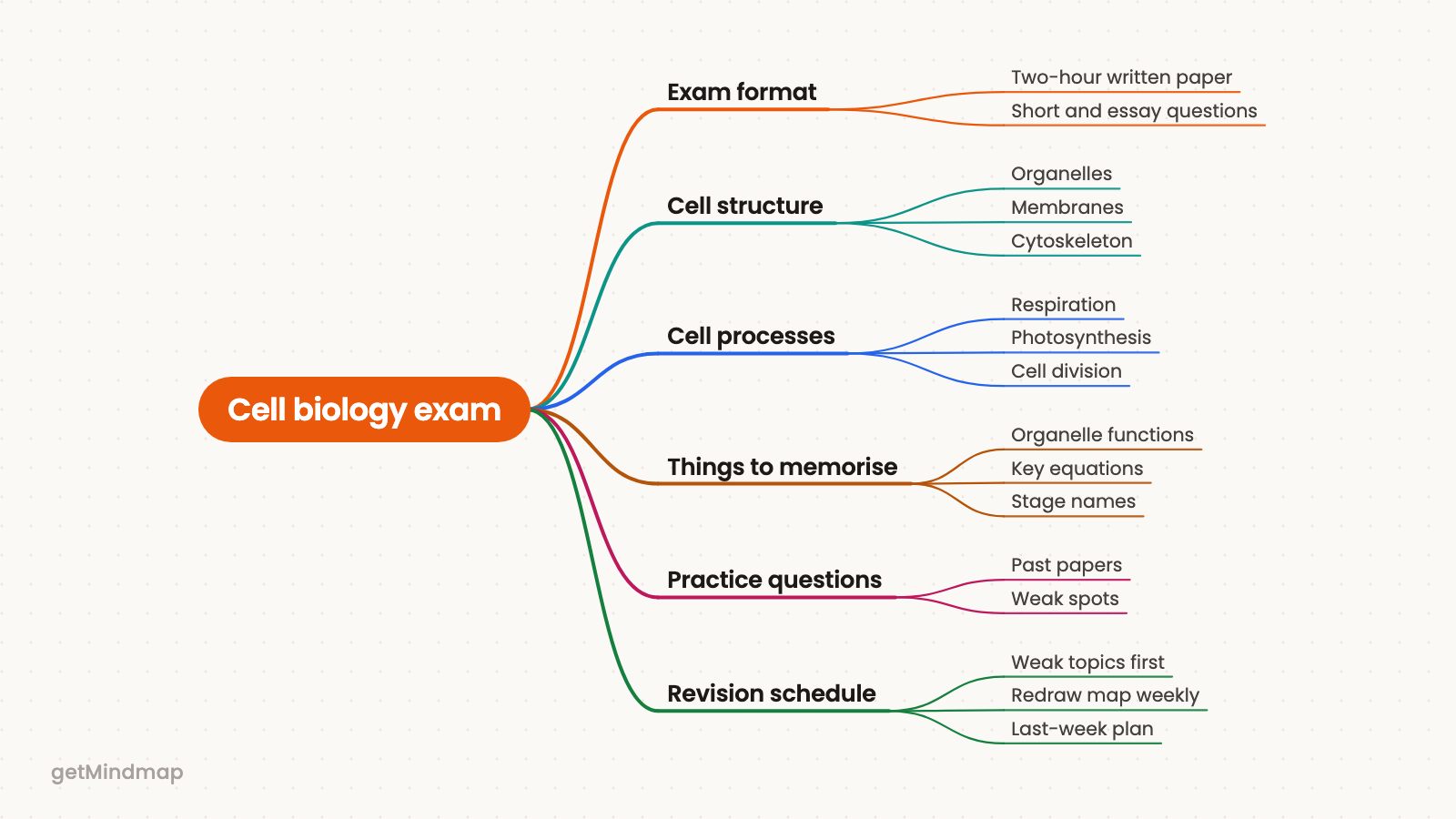
A step-by-step method
1. Map the course
Put the course name in the centre and add the six branches. Fill in Exam format first, then list the syllabus topics under Topics. Add Key concepts and Things to memorise as you go. Keep every node to a few words; the detail lives in your notes, and the map only has to point to it.
2. Find the weak branches
Go through the topics and mark each one honestly: confident, shaky or lost. Use the practice questions to check, since it is easy to feel confident about something you have only read. Two or three branches usually need most of your time.
3. Expand only those
Add detail only where you are weak. Leave the strong branches short. This keeps the map readable and stops you spending a week re-reading the topics you already know. In getMindmap, you can expand a single branch with AI and then edit the result, which saves some typing, but you still need to check it against your lecture notes.
4. Test yourself
This is the step that does the work. Look at the map, then hide it and redraw it blank on a fresh sheet, as much as you can remember. Compare the two and mark what you missed. A second option is to fold or cover a branch, say out loud what is under it, and then open it to check. Actively recalling material, and having to work out how topics connect, tends to help more than rereading does. Repeat the redraw on later days and you will see the gaps shrink.
5. Plan the last week
Fill in the Revision schedule branch by working back from the exam. Give the weak branches the most sessions, put a full redraw of the map early in the week, and leave the last day for a light pass over Things to memorise and the exam format. Add at least one timed practice paper if the exam is written.
Using pasted lecture notes
If you have typed lecture notes, you can paste them into getMindmap and get a first draft of the map in a minute. A map built from your own notes follows the structure of what your lecturer actually taught, which is closer to the exam than a map built from a bare topic name. Add the syllabus or the list of learning outcomes to the same paste if you have it. Then read the draft critically: remove what the exam will not ask, and add what the AI missed.
Mistakes to avoid
- Copying the textbook into the map. If the map has as much text as the chapter, it is not helping you see anything. Cut it down to short phrases.
- Never testing yourself. A map you only look at becomes a poster. Redraw it, fold it, or explain it to someone.
- Making it the night before. Building the map takes time and shows you what you do not know. If you do it the night before, you learn that too late to fix it. Make the first version early and revisit it often.
- Skipping the exam format. Knowing a topic and answering a question about it in forty minutes are different skills.
Try it
To see the method on your own course, paste your notes into the free try at map.getmindmap.com/try (no account needed), or open the exam revision template and start with the branches already set up. For more on turning notes into study maps, see AI study guides for exam preparation.